Medicinal mushrooms can feel complicated at first, especially when you start seeing words like polysaccharides, beta-glucans, triterpenes, sterols, antioxidants, and adaptogens. These terms sound technical, but they all point back to one basic idea: mushrooms are whole living systems made up of many different compounds that work together.
This is especially important when talking about mushroom tinctures. A well-made medicinal mushroom tincture is not about isolating one “magic” ingredient. It is about preparing the mushroom in a way that makes its naturally occurring compounds more available. Some mushroom compounds help the immune system recognize and respond to challenges. Some are studied for their role in inflammation, stress response, and cellular protection. Others are part of the mushroom’s structure, nutrition, and long-term wellness value.
Turkey Tail is one of the clearest examples. It is widely known for its polysaccharides and beta-glucans, including the well-studied compounds PSK and PSP. Reishi is known for both beta-glucans and triterpenes. Chaga, Cordyceps, Lion’s Mane, Shiitake, and Maitake each bring their own mix of compounds into the broader world of functional mushrooms.
Looking at these compounds one by one makes it easier to understand what medicinal mushrooms are, why extraction matters, and why a dual-extracted mushroom tincture can be a practical way to bring them into a daily routine.
Polysaccharides
Polysaccharides are long chains of natural sugars found in mushrooms that are widely studied for immune activity and gut-related immune effects.
For someone new to medicinal mushrooms, polysaccharides are one of the best places to start. They are foundational mushroom compounds, found across many of the most commonly used functional mushroom species, including Turkey Tail, Reishi, Lion’s Mane, Shiitake, Maitake, and others.
Many medicinal mushroom polysaccharides are water-soluble, which helps explain why hot water extraction matters. Traditional preparation often involved simmering mushrooms for long periods, allowing heat and water to help release these compounds from the mushroom’s tough cell structure. Modern hot water extraction follows the same basic principle in a more controlled way.
In research, mushroom polysaccharides are most often discussed in relation to immune modulation. Gut health also comes into the conversation because so much immune activity happens in and around the digestive system. When people talk about the immune-supporting qualities of medicinal mushrooms, polysaccharides are often one of the main groups of compounds they are referring to.
Beta-Glucans
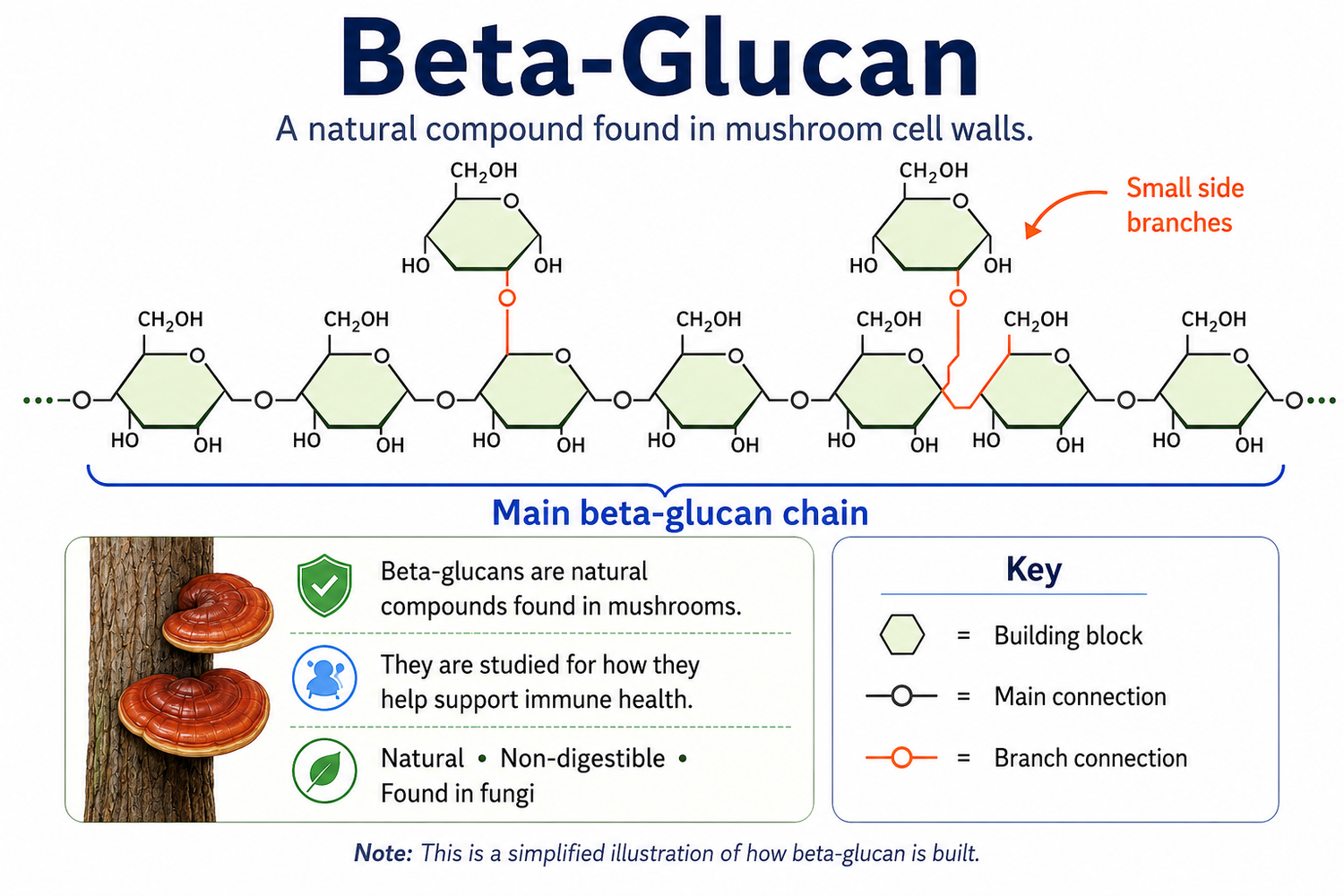
Beta-glucans are a major type of mushroom polysaccharide and are among the best studied compounds for immune modulation.
More specifically, mushroom beta-glucans are known for interacting with immune receptors and influencing immune cells such as macrophages, monocytes, dendritic cells, and natural killer cells. Their structure is part of what makes them biologically active, which is one reason beta-glucan content is often used as a quality marker in medicinal mushroom products.
Turkey Tail mushroom is one of the most important examples. Turkey Tail contains protein-bound beta-glucans known as PSK, or polysaccharide-K, and PSP, or polysaccharopeptide. These compounds have been researched extensively, especially in Japan and China, and they are a major reason Turkey Tail has become one of the most respected medicinal mushrooms in the world.
For customers comparing Turkey Tail mushroom tinctures, powders, capsules, or extracts, beta-glucans are one of the key terms to understand. They help explain why proper extraction matters, why fruiting body quality matters, and why Turkey Tail has such a strong reputation in the functional mushroom world.
Triterpenes
Triterpenes are compounds found especially in Reishi and are often associated with its bitter taste.
They are different from polysaccharides and beta-glucans because many triterpenes are alcohol-soluble. This is one of the main reasons Reishi tinctures are often dual-extracted with both hot water and alcohol. Hot water helps draw out water-soluble compounds like polysaccharides and beta-glucans, while alcohol helps extract compounds like triterpenes.
In the literature, Reishi triterpenes, including ganoderic acids, are studied for anti-inflammatory, antioxidant, and other biological activities. Reishi is the mushroom most commonly associated with triterpenes, although smaller amounts of related compounds can also be found in other Ganoderma species and some other medicinal mushrooms.
This is also where the difference between a simple mushroom tea and a dual-extracted mushroom tincture becomes important. Tea can be useful for water-soluble compounds, but it does not fully capture alcohol-soluble compounds in the same way. A dual-extracted tincture is designed to gather a broader spectrum of what the mushroom has to offer.
Antioxidants
Antioxidants are compounds that help protect cells from oxidative damage by neutralizing reactive molecules often called free radicals.
This means they help limit a kind of chemical wear and tear that can build up in the body through normal metabolism and environmental exposure. Mushrooms contain antioxidant compounds from more than one category, including ergothioneine, phenolic compounds, and in some cases compounds that overlap with the other groups described here.
In mushroom research, antioxidant activity is one of the recurring reasons medicinal mushrooms are studied for long-term health support. Chaga, Reishi, and Cordyceps are especially noted for antioxidant activity, although many edible and medicinal mushrooms contain antioxidant compounds.
For people exploring mushroom tinctures, antioxidants are part of the bigger picture. They are one more example of how functional mushrooms support the body through multiple pathways rather than through one single ingredient.
Sterols
Sterols are naturally occurring compounds in mushrooms, especially ergosterol, that help form fungal cell membranes.
A simple way to understand sterols is to think of them as part of the mushroom’s internal architecture. In fungi, ergosterol plays a role similar to the role cholesterol plays in animal cells, helping maintain membrane structure and function.
Ergosterol also matters nutritionally because when mushrooms are exposed to ultraviolet light, it can be converted into vitamin D2. That makes mushrooms one of the few non-animal foods connected to this vitamin D pathway.
Sterols like ergosterol are present across nearly all mushroom species, including Shiitake, Oyster mushrooms, and Button mushrooms. They may not get as much attention as beta-glucans or triterpenes, but they are still part of the larger chemistry that makes mushrooms unique as both food and functional ingredients.
Adaptogens
An adaptogen is a traditional herbalism term for a natural substance that helps the body respond to stress and maintain resilience over time.
Adaptogen is different from terms like polysaccharide, beta-glucan, or triterpene. Those words describe specific compounds found in mushrooms. Adaptogen describes a broader functional idea. It refers to the way a whole mushroom may support the body across time, especially through the immune, nervous, and endocrine systems.
In herbalism and Chinese medicine, mushrooms described as adaptogenic are usually taken regularly, not as a quick fix. Reishi, Cordyceps, Lion’s Mane, and Turkey Tail are often discussed in this broader wellness category, each with its own traditional use and modern research profile.
In modern research, this kind of support is often discussed through stress-response pathways such as the hypothalamic-pituitary-adrenal axis. The term adaptogen is less chemically precise than beta-glucan or triterpene, so it is best understood as a pattern of long-term support that comes from the combined activity of many compounds working together.
Why Extraction Matters in Medicinal Mushroom Tinctures
Most medicinal mushroom compounds are held inside tough fungal cell walls that include chitin, a durable fibrous material. This is part of why preparation matters so much. Simply eating a tough medicinal mushroom raw or taking a poorly prepared product may not make the same compounds available in the same way.
Hot water extraction is especially important for polysaccharides and beta-glucans. Alcohol extraction is especially important for alcohol-soluble compounds like Reishi triterpenes. A dual-extracted mushroom tincture uses both methods, helping draw out a fuller range of compounds from the mushroom.
This is one reason Sugarshack focuses on carefully made medicinal mushroom tinctures. The goal is not to reduce a mushroom to one compound or one trend. The goal is to honor the full organism, prepare it properly, and make it accessible as part of a daily wellness routine.
The Bigger Picture
Medicinal mushrooms are best understood as integrated systems. Polysaccharides, beta-glucans, triterpenes, antioxidants, sterols, and adaptogenic activity all help explain different parts of the story.
Turkey Tail shows how powerful beta-glucans and polysaccharides can be. Reishi shows why dual extraction matters for both water-soluble and alcohol-soluble compounds. Chaga, Cordyceps, Lion’s Mane, Shiitake, and Maitake each add their own character to the larger world of functional mushrooms.
At Sugarshack, we see mushroom tinctures as a bridge between traditional mushroom use and modern practical wellness. Grown and prepared with care in the Hudson Valley, these mushrooms are part of a larger cycle of food, medicine, cultivation, compost, and connection. The more you understand what is inside them, the easier it becomes to see why proper growing, proper sourcing, and proper extraction matter.