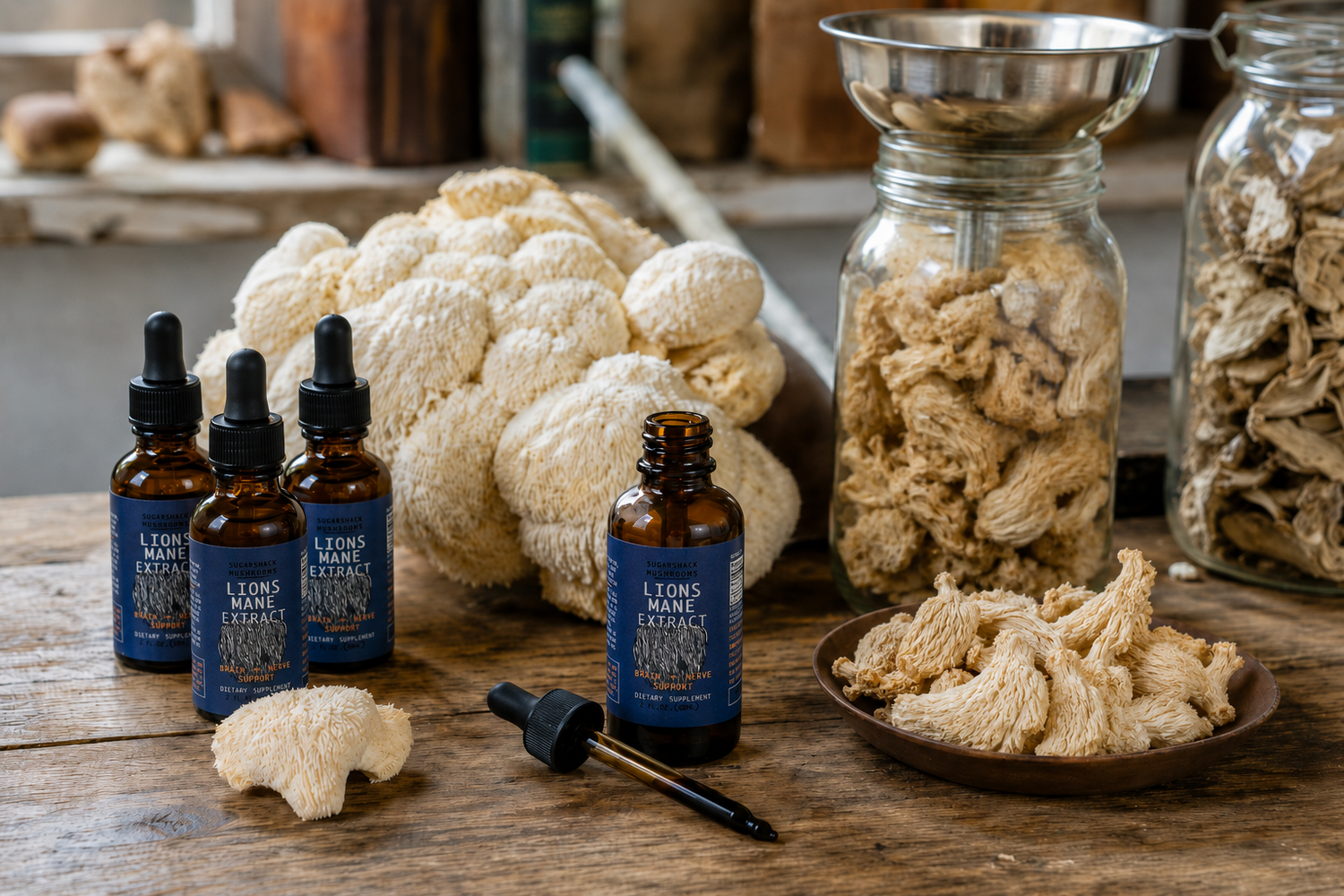
Lion’s Mane is one of the most recognizable mushrooms in the world. Instead of a cap and stem, it grows in soft white clusters with long cascading spines, giving it the look of a little forest creature, a frozen waterfall, or the mane of a lion. Its scientific name is Hericium erinaceus, and it is both a delicious edible mushroom and one of the most widely discussed functional mushrooms today.
For many people, Lion’s Mane is the mushroom that opens the door. It is unusual enough to catch your attention, simple enough to cook, and fascinating enough to keep learning about. It belongs just as comfortably in a skillet as it does in a conversation about forest ecology, traditional medicine, and modern research into brain and nerve health.
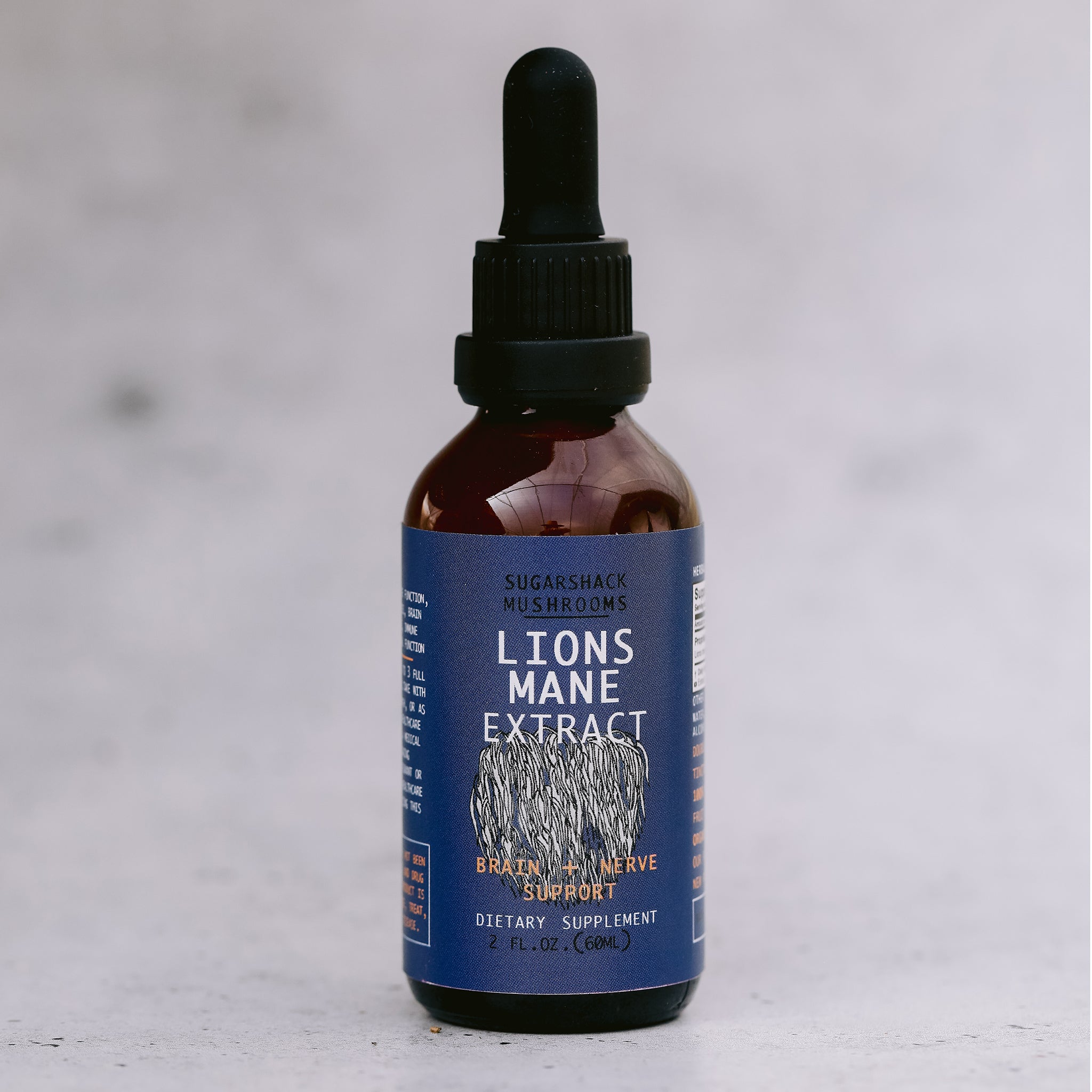
Today, Lion’s Mane mushroom is used as a fresh culinary mushroom, a dried mushroom, a powder, a grow-your-own kit, and a daily tincture. A Lion’s Mane mushroom tincture is one of the easiest ways to use this mushroom consistently because it is already extracted, simple to measure, and easy to add to a daily routine.
At Sugarshack, Lion’s Mane is one of the mushrooms that best expresses what we love about this work. It is food, medicine, education, and cultivation all wrapped together. It lets people experience mushrooms through cooking, through daily wellness routines, and through the simple wonder of watching a strange white cluster slowly grow from a block on the kitchen counter.
What Is Lion’s Mane Mushroom?
In the wild, Lion’s Mane grows on hardwood trees in temperate forests across the Northern Hemisphere, including North America, Europe, and Asia. It is especially associated with older beech and oak trees, where it fruits from wounds or decaying sections of wood. Because it depends on mature forest habitat, wild Lion’s Mane should be harvested with care. Taking only what you need, leaving some behind, and returning to the woods with respect are all part of understanding the mushroom itself.
Lion’s Mane has also become an important cultivated mushroom. Farms can grow it indoors on hardwood-based substrates, where it forms dense white clusters under clean, humid, carefully controlled conditions. This makes it possible to enjoy Lion’s Mane without relying only on wild harvests, while also allowing growers to produce consistent mushrooms for fresh eating, drying, extracts, and grow-your-own kits.

Lion’s Mane Mushroom Benefits and Research
Lion’s Mane has a long history of traditional use, and modern research has focused especially on its relationship to brain, nerve, and cognitive health. The compounds that get the most attention in Lion’s Mane research are hericenones and erinacines. Hericenones are primarily associated with the fruiting body, while erinacines are most often studied from the mycelium. Both groups have been studied for their relationship to nerve growth factor, often shortened to NGF, a protein involved in the growth, maintenance, and survival of certain nerve cells.
This is one reason Lion’s Mane is often associated with memory, focus, and nerve support. Much of the strongest mechanistic research is still preclinical, meaning it comes from laboratory and animal studies, while human studies remain smaller and still developing. The research is promising, and more large clinical trials are needed, but Lion’s Mane remains one of the most compelling mushrooms in the field of functional mushroom research.
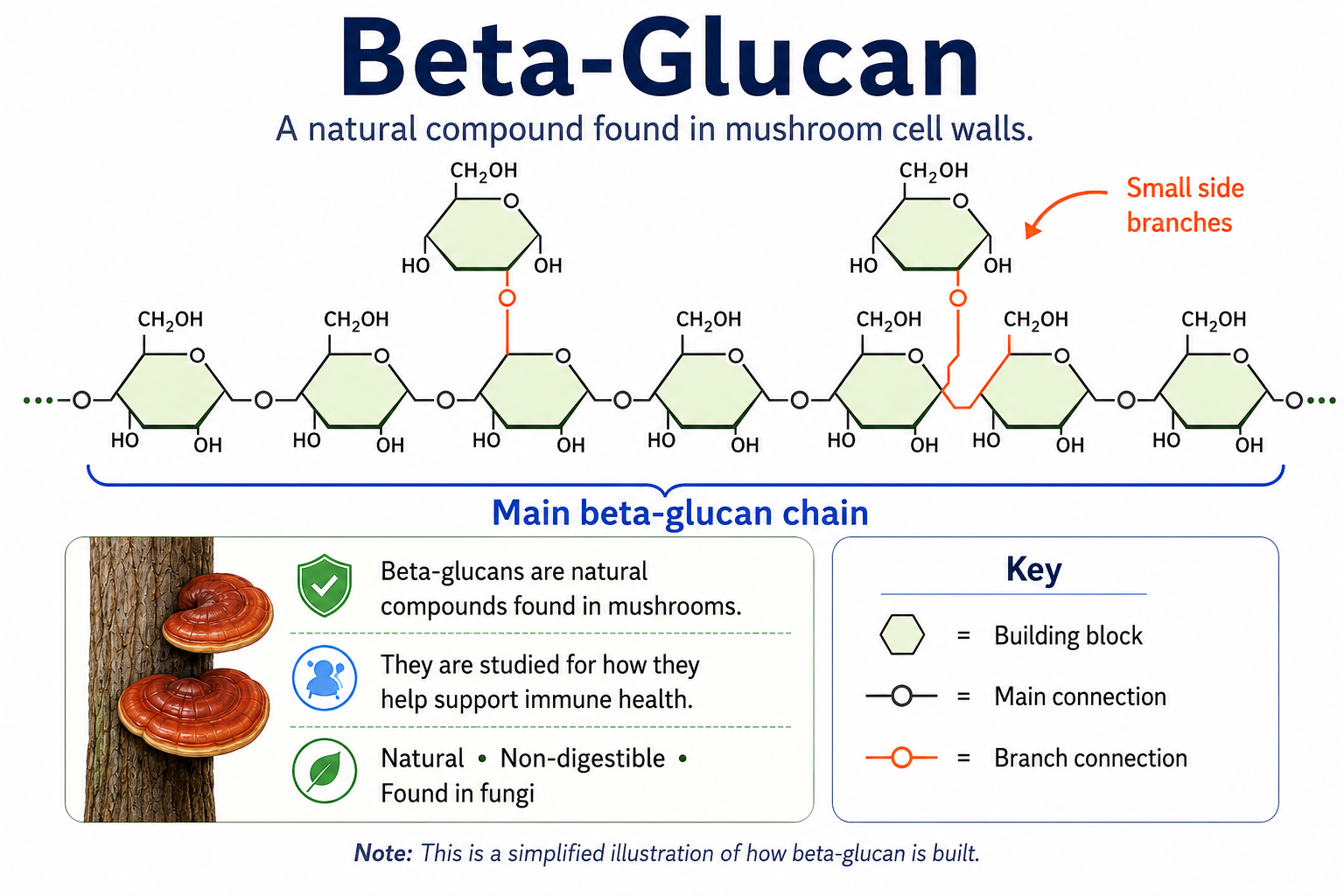
Lion’s Mane also contains polysaccharides, including beta-glucans. These are complex carbohydrates found in mushroom cell walls that are widely studied for their role in immune and gut health. In this way, Lion’s Mane belongs to the larger group of functional mushrooms that are valued for more than one single compound. The whole mushroom contains a range of constituents, and different preparations can emphasize different parts of that profile.
A good way to think about Lion’s Mane is as a mushroom of connection. In the forest, it helps break down wood and return nutrients to the living system around it. In the body, researchers are interested in how its compounds may support communication, repair, and resilience within the nervous system. That connection between the ecological role of the mushroom and the way people have come to understand it is part of what makes Lion’s Mane so interesting.
Lion’s Mane for Memory, Focus, and Nerve Support
Lion’s Mane tincture is often used by people who are interested in focus, memory, mental clarity, and nervous system support. These uses come from a combination of traditional use, modern research, and the mushroom’s unique chemistry.
It is important to talk about this carefully. Lion’s Mane is not a quick fix, and it should not be presented as a cure or treatment for disease. A better way to understand it is as a functional mushroom that may support the body over time when taken consistently. Like many herbal and mushroom preparations, the value is often in regular use, proper extraction, and overall quality.
For people who use Lion’s Mane tincture daily, the goal is usually support rather than a single dramatic effect. Some people take it in the morning as part of a focus routine. Others take it as part of a broader approach to long-term brain, nerve, immune, and gut health.
Lion’s Mane Fruiting Body vs. Mycelium
As Lion’s Mane has become more popular, quality has become more important. Many products on the market use different parts of the mushroom and different production methods, which can make labels confusing.
The fruiting body is the visible mushroom. It is the part you cook, harvest, and recognize as Lion’s Mane. The mycelium is the root-like fungal network that grows through wood, grain, or another substrate. Mycelium is an important part of the organism, and some Lion’s Mane research has looked closely at compounds found in mycelium. The issue for customers is that many mycelium-based products are grown on grain and may contain a significant amount of leftover starch from that grain.
This is why fruiting body Lion’s Mane tinctures have become so important for people who want a clear, mushroom-forward extract. The fruiting body is naturally rich in polysaccharides and other mushroom compounds, and it avoids the grain-heavy issue that can come with some mycelium-based products. A good Lion’s Mane mushroom tincture should clearly say what part of the mushroom is used, how it is extracted, and whether fillers or grain are present.
Why Choose a Dual Extracted Lion’s Mane Tincture?
A Lion’s Mane tincture is different from eating the mushroom fresh. Fresh Lion’s Mane is food. A tincture is a concentrated preparation made to pull out beneficial compounds and make them easy to take regularly.
Mushroom compounds are held inside a tough cellular structure. Traditional preparations often used long cooking times, especially teas and decoctions, to draw water-soluble compounds from mushrooms. Modern dual extraction builds on that idea by using both hot water and alcohol.
Hot water is especially important for polysaccharides such as beta-glucans. Alcohol can help draw out additional alcohol-soluble constituents from the mushroom. For Lion’s Mane, dual extraction is best understood as a broad preparation method rather than a guarantee of any one compound. The goal is to create a full-spectrum Lion’s Mane tincture that carries a wide range of mushroom constituents in a form that is simple to use every day.
For our tinctures, we use a dual extraction process designed to capture a broad range of mushroom compounds. We start with fruiting bodies in organic cane alcohol, then follow with a long hot water extraction. The two extracts are blended into a finished Lion’s Mane mushroom tincture that is shelf stable, concentrated, and easy to add to a daily routine.
For us, extraction is part of the same care that begins in the grow room. The mushroom is cultivated, harvested, processed, and extracted with attention to each step. That is what allows a tincture to carry the strength of the mushroom in a form that fits easily into daily life.
How to Take Lion’s Mane Tincture
Lion’s Mane tincture can be taken directly under the tongue or added to a small amount of water, tea, coffee, juice, or another drink. Many people prefer to take it in the morning because Lion’s Mane is often associated with focus and clarity. Others take it at the same time every day simply because consistency makes it easier to build into a routine.
Most people take Lion’s Mane consistently rather than occasionally. Functional mushrooms tend to fit best as part of a regular rhythm. A tincture makes that easier because it is already extracted and measured by the dropper.
Lion’s Mane can also be used in other forms. Fresh mushrooms are best treated as food and cooked into meals. Dried Lion’s Mane can be simmered into teas, broths, and soups. Powder can be added to coffee, smoothies, oatmeal, or recipes. A dual extracted tincture is the simplest option for people who want a prepared Lion’s Mane extract that is easy to take every day.
As with any supplement, people who are pregnant, nursing, taking medication, managing a medical condition, or preparing for surgery should check with a qualified healthcare professional before using mushroom tinctures. Lion’s Mane is widely eaten as food, but concentrated extracts deserve the same thoughtfulness as any other herbal or functional product.

Why Sugarshack Lion’s Mane Tincture Is Different
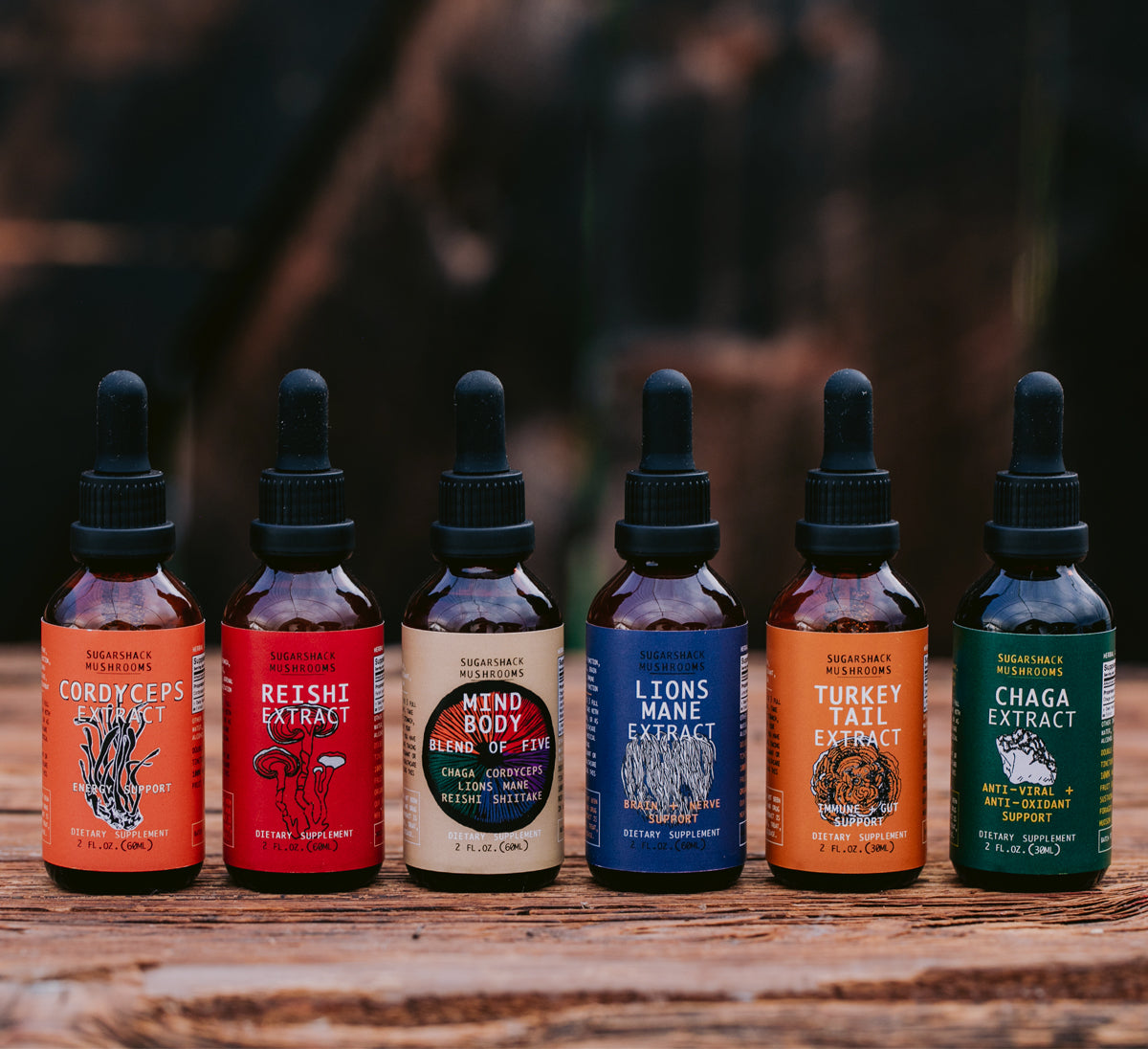
Many Lion’s Mane products on the market are made at large scale, often from powders, imported ingredients, or mycelium grown on grain. At Sugarshack, our Lion’s Mane is grown and processed on our farm in the Hudson Valley, then made into small-batch tincture using 100% mushroom fruiting body.
We use no starch, fillers, or mycelium-fermented grain. We make our tinctures by hand in small batches, using glass containers and high quality ingredients. Keeping the process close matters to us because Lion’s Mane quality begins long before the tincture bottle is filled. It begins with the substrate, the grow room, the harvest timing, the drying, and the extraction itself.
This is one of the biggest differences between a true fruiting body Lion’s Mane tincture and many mass-market mushroom products. For us, the tincture is an extension of the farm. It carries the care of cultivation into a daily preparation that people can actually use.
Lion’s Mane Mushroom Tincture FAQ
What is Lion’s Mane mushroom tincture good for?
Lion’s Mane mushroom tincture is best known for its potential support of memory, focus, mood, nerve health, immune function, and gut health, though human research is still developing.
Does Lion’s Mane tincture help with focus?
Lion’s Mane is often used for focus because its compounds are being studied for their relationship to nerve growth factor and cognitive function, though more large human studies are needed.
Is Lion’s Mane tincture better than powder?
Lion’s Mane tincture is already extracted and easy to take daily, while powder is usually added to drinks or food. A dual extracted Lion’s Mane tincture is designed to draw out a broad range of mushroom compounds, especially water-soluble polysaccharides and beta-glucans.
What is the difference between Lion’s Mane fruiting body and mycelium?
The fruiting body is the visible mushroom, while mycelium is the root-like fungal network. Fruiting body extracts are valued because they are mushroom-forward and avoid the grain-heavy issue found in many mycelium-on-grain products.
When should I take Lion’s Mane tincture?
Many people take Lion’s Mane tincture in the morning because it is often associated with focus and clarity. The most important part is taking it consistently in a way that fits your routine.
Lion's Mane mushroom tincture is one of the easiest ways to experience the benefits of this remarkable functional mushroom. Whether you're interested in supporting focus, memory, nerve health, or simply adding a mushroom-forward extract to your daily routine, a dual extracted Lion's Mane tincture offers a convenient, concentrated preparation that fits seamlessly into modern life. Learn what makes Lion's Mane special, how extraction works, and why quality matters when choosing a tincture.